Just wanted to let all of you know that we support space-age tooth extractions.
Monday, July 12, 2010

Thursday, May 27, 2010
Implants for hopeless teeth
Patients who have failing teeth get concerned that it will be tough to chew when they lose them. Molars are like your thumbs--they are really handy for eating a proper diet of fresh foods. Without them, you're a bit handicapped.
The other part of losing useful teeth? Once the tooth is gone, the bone support atrophies, or disappears, soon after the tooth is removed unless something is done to preserve the bone.
That's where implants can help. If placed immediately after tooth extraction, supporting bone is preserved, and the process of restoring a useful tooth begins right away. Here's a case where that happened.
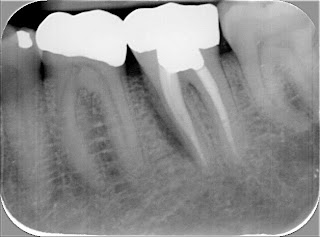
The tooth at center has a hopeless outlook, becasue the root has split, and an abscess is starting on the left root. The patient really wanted to chew with that tooth--it is his favorite chewing side.
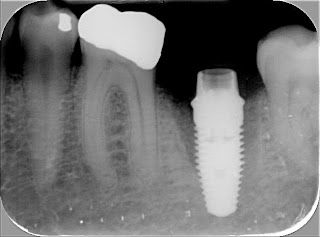
We removed the tooth and immediately secured an implant in the site.
 We then restored the stable implant with a crown 2 months after extraction, seen in the lower right corner of the x-ray.
Implants can really change your life. Call us for a free consultation with an exam and x-rays (Value $205) to discuss how we can help you!

Monday, May 24, 2010
One-day smile makeover--direct veneers
This patient was graduating with her doctorate in about a week, and wanted to eliminate the gaps and "the snaggle tooth" from her smile before she moved home. We recommended direct composite resin veneers. This treatment was done in a single visit, and is the most conservative aesthetic choice for improving smiles. It did not involve any cutting of teeth.


Direct composite veneers are much less expensive than costly veneer treatments which usually require cutting or trimming tooth structure. She was thrilled with the outcome, and so were we! Call us today for a free consultation (value $165) to find out if direct veneers a re the right choice for you.


Thursday, May 13, 2010
Fellowship Achieved for Implant Dentistry
Dr. Rafoth recently received his fellowship degree from the American Dental Implant Association!
This advanced degree in implant surgery and implant dentistry was presented after he completed an extensive hands-on training program. Although he has been performing implant surgery since 2000, Dr. Rafoth wanted to continue his education and improve his surgical techniques with ongoing training.
Our office is providing the latest advances and procedures for implant dentistry, including computed tomography (CT) imaging, computer-aided implant placement, mini dental implants, bone grafting, and more.
We are certain that implants can change the lives of our patients, becasue we have seen the results with many patients we have treated! If you want to feel confident about eating, speaking, and smiling again, call our office today for a free consultation (value $205) to see how implants can help you.
This advanced degree in implant surgery and implant dentistry was presented after he completed an extensive hands-on training program. Although he has been performing implant surgery since 2000, Dr. Rafoth wanted to continue his education and improve his surgical techniques with ongoing training.
Our office is providing the latest advances and procedures for implant dentistry, including computed tomography (CT) imaging, computer-aided implant placement, mini dental implants, bone grafting, and more.
We are certain that implants can change the lives of our patients, becasue we have seen the results with many patients we have treated! If you want to feel confident about eating, speaking, and smiling again, call our office today for a free consultation (value $205) to see how implants can help you.
Tuesday, April 27, 2010
The standard for oral cancer screening is here!
Oral cancer prevalence is on the rise. Human Papilloma Virus (HPV) has recently been recognized as a significant factor in oral cancer. Usually, the first healthcare providers to recognize oral cancer are dentists. With the increased risk in the general population, we were interested in offering our patients the best way to screen for the disease. So we now offer the Identafi 3000, a visible-light instrument that can differentiate between healthy and abnormal oral tissues.
The Identafi 3000 is easy for to use, is comfortable for you, and can better identify signs of cancer at an earlier stage than the traditional "see and feel" oral cancer screening.
We perform an annual screening with the Identafi 3000 for all our patients. There is a reasonable cost associated with this service. But the value of early detection outweighs the cost of treatment and rehabilitation associated with advanced-stage oral cancer.
Call us today to schedule an examination that includes the Identafi 3000. For more about the instrument, visit http://www.trimira.net/.
The Identafi 3000 is easy for to use, is comfortable for you, and can better identify signs of cancer at an earlier stage than the traditional "see and feel" oral cancer screening.
We perform an annual screening with the Identafi 3000 for all our patients. There is a reasonable cost associated with this service. But the value of early detection outweighs the cost of treatment and rehabilitation associated with advanced-stage oral cancer.
Call us today to schedule an examination that includes the Identafi 3000. For more about the instrument, visit http://www.trimira.net/.
Wednesday, April 14, 2010
Medical Evaluation for Periodontal Disease
When you have a major illness or injury, think about what has to happen to get better: you go to the doctor, the doctor may take some blood, orders specific tests. Those tests identify certain facts about your problem. Then the doctor uses these facts to decide how to help you.
The same methods are now being applied in dentistry for periodontal disease. Specific tests are important for identifying the presence of infection, the effects of infection on your body, and the presence of genes that put you at greater risk for the disease.
In our office, we see many patients have medical complications as well as conventional dental problems. But when we review their medical history, and find risk factors for periodontal disease, we work with the patient's doctors to run specific tests. These tests can detect harmful bacteria, identify abnormal inflammation, find the gene for gum disease, or identify when other medical conditions are liable to cause problems with oral health. With that specific information, we can treat them using the proper procedures. We also use medical testing to confirm that patients are recuperating after we treat them.
There is a service, called OralDNA Labs, that is now doing many of these tests for patients at the dental office instead of going to their physician. For more information about these tests, visit www.oraldnalabs.com. To discuss how we can help you treat periodontal disease or medical evaluations for your oral health, call us today!
The same methods are now being applied in dentistry for periodontal disease. Specific tests are important for identifying the presence of infection, the effects of infection on your body, and the presence of genes that put you at greater risk for the disease.
In our office, we see many patients have medical complications as well as conventional dental problems. But when we review their medical history, and find risk factors for periodontal disease, we work with the patient's doctors to run specific tests. These tests can detect harmful bacteria, identify abnormal inflammation, find the gene for gum disease, or identify when other medical conditions are liable to cause problems with oral health. With that specific information, we can treat them using the proper procedures. We also use medical testing to confirm that patients are recuperating after we treat them.
There is a service, called OralDNA Labs, that is now doing many of these tests for patients at the dental office instead of going to their physician. For more information about these tests, visit www.oraldnalabs.com. To discuss how we can help you treat periodontal disease or medical evaluations for your oral health, call us today!
Thursday, April 8, 2010
How We Decided to Offer Sedation Dentistry
Before I started practicing in 1998, I had the unique privilege to learn oral surgical procedures at a local hospital. The differences between hospital-based dentistry and general dentistry were numerous. The biggest difference was how patients were cared for comfortably with respect to their level of anxiety and their medical conditions. In many cases, comfortable treatment meant sedation or general anesthesia was used. From that point on, I knew I should position our practice to offer sedation dentistry.
Before we offered sedation to patients, there were a number of steps we had to take. First, I wanted my team well-educated and trained to administer safe sedation to patients. We took an extensive amount of time at several continuing education facilities. And I make sure that they receive regular reviews of all sedation procedures and emergency protocols. Being a part of the Dental Organization for Conscious Sedation (DOCS) keeps me and my team up-to-date about all aspects of sedation dentistry.
Next, I made sure that we were prepared with the right equipment and medications to monitor patients, and manage their needs. And I made sure that we arranged to focus on one patient's care at a time while they were under sedation.
I know many patients who want sedation are also in need of high-level rehabilitation--in a lot of cases, that means significant amounts of dentistry. So I prepared my practice to provide comprehensive care. That means we are trained to perform the standard of care not only for fillings, crowns, and cleanings, but also for oral surgery, root canals, dentures, gum surgery, and implants.
Finally, offering a comfortable environment that provides "TLC" and high-level customer service is necessary to work out details for people who require sedation or comprehensive care. This means we spend the time it takes to listen to a patient's specific needs and desires. We discuss how we can realistically and reasonably offer sedation dentistry to get them what they want.
It has been really rewarding for me to know that we have treated so many patients with sedation dentistry that would otherwise never be able to improve their dental health. The preparations to offer sedation have really paid off, because we know we are providing safe and effective ways to keep them comfortable during care.
Before we offered sedation to patients, there were a number of steps we had to take. First, I wanted my team well-educated and trained to administer safe sedation to patients. We took an extensive amount of time at several continuing education facilities. And I make sure that they receive regular reviews of all sedation procedures and emergency protocols. Being a part of the Dental Organization for Conscious Sedation (DOCS) keeps me and my team up-to-date about all aspects of sedation dentistry.
Next, I made sure that we were prepared with the right equipment and medications to monitor patients, and manage their needs. And I made sure that we arranged to focus on one patient's care at a time while they were under sedation.
I know many patients who want sedation are also in need of high-level rehabilitation--in a lot of cases, that means significant amounts of dentistry. So I prepared my practice to provide comprehensive care. That means we are trained to perform the standard of care not only for fillings, crowns, and cleanings, but also for oral surgery, root canals, dentures, gum surgery, and implants.
Finally, offering a comfortable environment that provides "TLC" and high-level customer service is necessary to work out details for people who require sedation or comprehensive care. This means we spend the time it takes to listen to a patient's specific needs and desires. We discuss how we can realistically and reasonably offer sedation dentistry to get them what they want.
It has been really rewarding for me to know that we have treated so many patients with sedation dentistry that would otherwise never be able to improve their dental health. The preparations to offer sedation have really paid off, because we know we are providing safe and effective ways to keep them comfortable during care.
Subscribe to:
Posts (Atom)